

In this module, we present a holistic and comprehensive framework of the various components that constitute the digital health literacy domain.
We analyze the various trends, prospects, and challenges of digital health technologies in health care, both in institutional and community settings.
We approach not only the different digital health technologies but also vital issues that have impact on the promotion and wider usability of digital health, namely issues around policy, ethical application, and educational support.
The main focus falls on the basic notions that will allow DIGIHEALTH project’s target groups (mainly assistive personnel in the healthcare), to better understand this upcoming field and to be able to upgrade their skills for the benefit of their beneficiaries.
Why is this module important?
The rapid growth of data has reshaped nearly every dimension of modern society. Data now serves as a fundamental driver of decision-making, problem resolution, and innovation across diverse sectors such as healthcare, business, science, and education. However, alongside these advancements, issues of data privacy and security continue to pose major challenges, particularly within the healthcare industry. When healthcare data is poorly governed or inadequately protected, it can become a significant source of risk rather than value (Faridoon, A., 2024).
In times when health care systems are struggling with security, privacy, and optimization, the technology is trying to give a big response in order to keep the situation under the radar, all while keeping it open for all the future developments (Adeghe et al., 2024). Inadequate data management may lead to serious consequences, including threats to patient safety, legal and regulatory penalties, reputational harm, financial losses, and reduced operational effectiveness. The increase in big data, specifically the quantity of electronic patient data, has helped researchers and practitioners visualize medical big data in a new light (Nazir et al., 2020). But, while the big data technologies are bringing a positive remark into the health care system, they do raise concerns about the safety and privacy of patient data, their exposure, and easy accessibility.
New and emerging technologies, especially blockchain and artificial intelligence (AI), present valuable opportunities to mitigate existing security weaknesses. Blockchain functions as a decentralized and tamper-resistant ledger, strengthening data integrity and transparency by ensuring that records cannot be altered without authorization. In parallel, artificial intelligence and machine learning (ML) support advanced cybersecurity capabilities, including real-time threat detection, proactive risk prediction, and automated monitoring of regulatory compliance (Conduah, A., et al., 2025).
So why is it important to protect the privacy of your date and ensure their security? One key reason is that individuals are presented with numerous incentives to disclose their personal data, making them likely to do so despite potential privacy risks. Many patients recognize and accept that sharing health data can contribute to improved medical outcomes. Evidence from a recent meta-analysis indicates that people are generally willing to relinquish a degree of control over their health information in exchange for perceived benefits, particularly when the data sharing has direct implications for their own health.
Another factor is the vast amount of personal health information that already exists beyond the boundaries of formal healthcare systems, which has significantly diminished individuals’ control over their data. Health-related information is frequently exchanged outside the scope of healthcare privacy regulations. Moreover, healthcare providers and insurance companies commonly commercialize anonymized medical records by selling them to third parties, including specialized data brokerage firms (Kasperbauer, T., 2019).
In this module, we will introduce the importance of data management, its privacy, and security, and how one can actually be sure they have handled the data correctly.
This course is designed to help care assistants, home caregivers, and healthcare trainers build the digital awareness and practical confidence needed to support patients in a connected care environment.
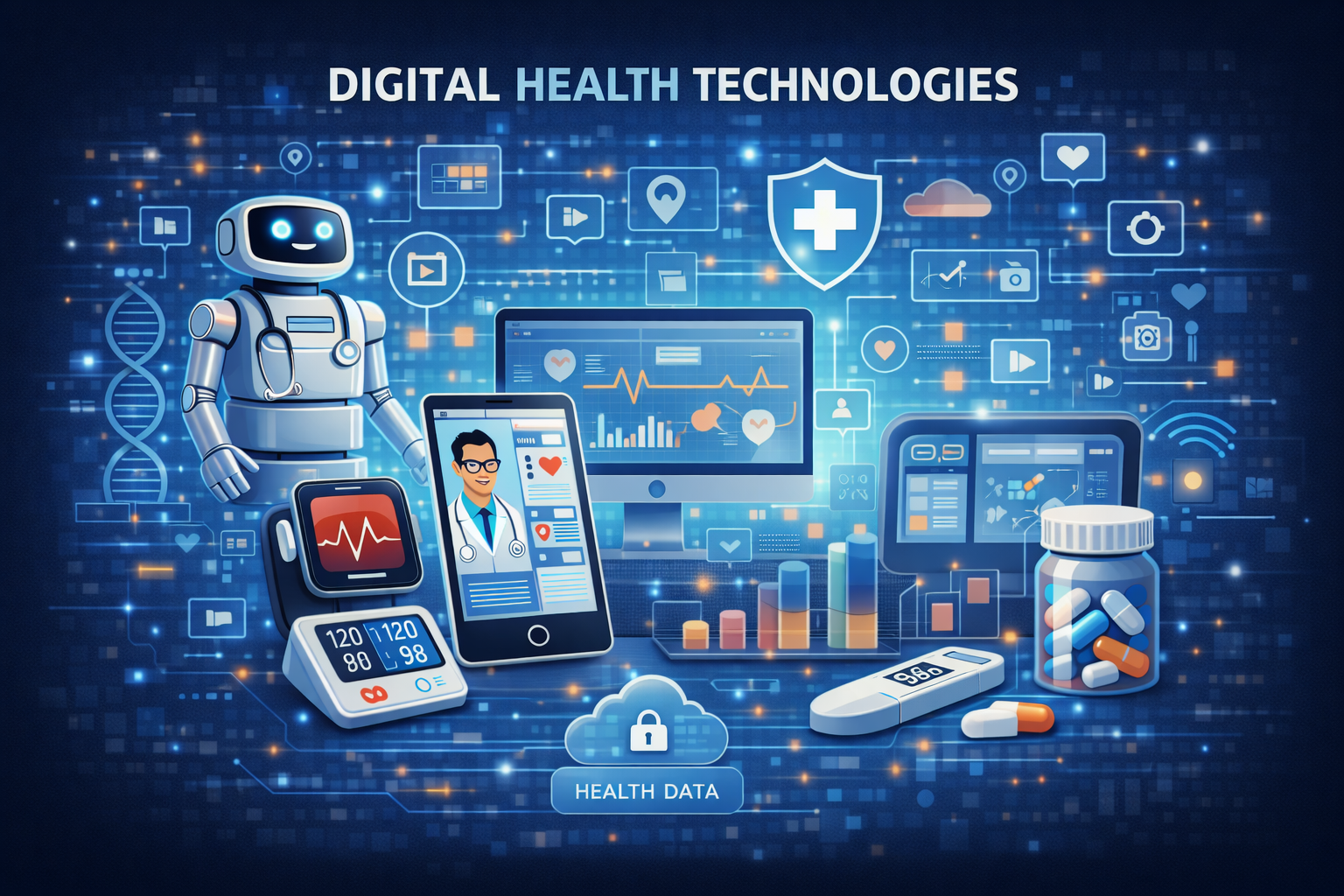
Across five focused units, we’ll look at how digital technologies are changing care: from video consultations and remote health monitoring, to smart devices, digital therapy management, and new communication tools between caregivers, patients, and doctors.
We will also address essential topics like online safety, professional responsibility in the use of tech, and how to keep up with constant innovation—without losing sight of the human relationship at the heart of care.
This course is not just about understanding digital health—it’s about using it, step by step, in real caregiving situations. By the end, you’ll be better equipped to:
- Use digital tools to assist your patients
- Communicate more effectively at a distance
- Work with telemedicine platforms safely
- Stay updated and feel more confident in the digital world
Above all, this course supports you in combining technology with care, so that no one is left behind in the digital transition of healthcare.
The final module focuses on the practical application of digital health technologies in caregiving scenarios. It includes case studies, simulation-based exercises, and projects designed to encourage learners to apply their digital health skills in real-world settings.